
Earn lifelong certificates from Cambridge English for each TKT module, recognized and respected worldwide.
TKT Preparation
The Teaching Knowledge Test is a series of modular tests that validate your knowledge of modern English language teaching methodology.
Our TKT preparation courses will help you systematise your teaching experience, deepen your understanding of methodology, and gain invaluable insights into contemporary approaches to English language teaching.

Why add TKT to your professional portfolio?
- International status
- Understanding communicative methodology
Transform your intuitive teaching into a structured system built on the core principles of the Communicative Approach.
- Recognition by the Ministry of Education and Science of Ukraine
For state school teachers, each module can be accredited as 30 hours of professional development.
- A head start for your career
Build a solid theoretical foundation before pursuing higher-level qualifications such as CELTA or DELTA.
Choose your course
New
TKT Module 1 Online Preparation Course
Enrolment in progress
- Course dates
- 20 October 2026 — 19 November 2026
- Tutors
-
Valeriia Sydorenko
- Course price
- 4 499 ₴ /92 €
New
TKT Module YL Online Preparation Course
Enrolment in progress
- Course dates
- 20 October 2026 — 19 November 2026
- Tutors
-
Alona Filipenko
- Course price
- 4 499 ₴ /92 €
New
TKT Module 2 Online Preparation Course
Enrolment in progress
- Course dates
- 26 October 2026 — 25 November 2026
- Tutors
-
Lidiya Simak
- Course price
- 4 499 ₴ /92 €
Plan your TKT course
Leave your contact details, and we’ll get in touch once new course dates are available.
Choose your TKT preparation pathway

TKT Module 1
Background to language learning and teachingThis module builds a foundational theoretical framework. It introduces Cambridge’s professional terminology, the essentials of linguistics, and the psychological aspects of language acquisition.
Who is this course for? Teachers who want to structure their theoretical knowledge, master professional ELT terminology, and understand the core logic of the Communicative Approach.
The course covers the following topics:
Describing language and language skills
An in-depth analysis of vocabulary, grammar, phonology, and pragmatics. You will also explore the specifics of developing receptive skills (reading and listening) and productive skills (writing and speaking).
Background to language learning
An overview of how learners acquire their first and second languages, the factors that influence this process (motivation, individual characteristics, age), and how to effectively analyse student errors.
Background to language teaching
A comprehensive review of modern methodologies and approaches, techniques for presenting new language, formats for practice activities, and types of assessment.

TKT Module 2
Lesson planning and use of resources for language teachingThis module focuses on the structure of a modern lesson. You will learn how to create balanced lesson plans, set clear objectives and take a critical approach to selecting and adapting teaching materials.
Who is this course for? Teachers who wish to optimise their lesson planning and make their lesson plans more structured, logical and effective.
The course covers the following topics:
Planning and preparing a lesson or a sequence of lessons
- Identifying lesson aims: main, subsidiary, and personal aims; factors that influence their formulation; and ways to specify them clearly.
- Components of a lesson plan: procedures, stages, timing, assumptions, interaction patterns, syllabus fit, and anticipating potential classroom problems.
- Syllabus design: determining a logical sequence for language structures, skills, topics, or projects.
Choosing assessment activities
The specifics of selecting tasks and exercises for formal and informal assessment of learner progress.
Selection and use of resources and materials
- Coursebooks and instructional materials: selection criteria and methods for adapting materials to suit the specific needs of your group.
- Supplementary materials and activities: types of extra tasks, their suitability, and criteria for selection and adaptation.
- Teaching aids: types of classroom equipment, technical resources, and their functions in the learning process.
- Teacher reference resources: tools that aid in lesson planning and serve as a foundation for professional reflection.
TKT Module 3
Managing the teaching and learning processThis module is dedicated to practical classroom interaction and creating a supportive learning environment. You will master the nuances of Classroom Management, learn how to flexibly adapt your teaching roles, analyse classroom language (both your own and your students'), and correct errors constructively.
Who is this course for? Teachers who want to establish seamless classroom discipline, optimise Teacher Talking Time (TTT), and use effective tools to manage group dynamics.
The course covers the following topics:
Teachers’ and learners’ language in the classroom
- Identifying functions of learners' language: recognising students' communicative intentions, analysing their typical expressions, communicative purposes, and the appropriateness of specific phrases.
- Categorising learners' mistakes: identifying and grouping student errors (such as spelling, incorrect verb forms, subject-verb agreement, etc.).
Classroom management and group dynamics
- Teacher roles: transitioning smoothly between various professional roles (such as manager, diagnostician, planner, and resource) depending on the stage of the lesson.
- Classroom management: effectively managing classroom space, establishing clear rules and routines, and implementing clear systems for praise and rewards.
- Grouping learners: evaluating different interaction patterns, rules and reasons for pairing students or dividing them into small groups.
Responding to learners' needs and providing feedback
- Adapting to learners: analysing individual student needs, introducing variety into lessons, and planning sessions tailored to the characteristics of a specific group.
- Correcting errors: modern correction techniques and the principles of applying them in various learning situations.
- Giving feedback: determining the main purpose and focus of feedback, practical ways of delivering it to learners.

TKT Module YL
Teaching Young Learners (aged 6–12)The course addresses the unique psychological, cognitive, and social development of children, helping you turn your lessons into an engaging and highly effective experience.
Who is this course for? Teachers who already work with children or plan to do so, wish to gain deep insights into child psychology and language acquisition, and are looking for highly practical classroom strategies.
The course covers the following topics:
Knowledge of young learners and principles of L2 learning
- Characteristics of young learners: how children perceive and acquire a foreign language.
- Developing learning, cognitive, and communication strategies: supporting children's broader developmental and study skills alongside their English language learning.
Planning and preparing lessons for young learners
- Lesson anatomy: a breakdown of young learner lesson plans and their essential components.
- Using coursebooks: how to select and adapt curriculum materials to meet the actual needs and levels of your learners.
- Supplementary resources: criteria for selecting, adapting, and effectively using game-based, visual, and digital materials.
Teaching young learners and classroom management
- Scaffolding: how to support learners through strategic teacher language and specialised techniques, enabling them to understand and use English independently.
- Practice activities: utilising consolidating tasks to ensure students build solid and lasting knowledge.
- Managing young learners in the classroom: the nuances of managing behaviour, maintaining attention, and fostering positive discipline.
Assessing young learners in the classroom
- Purposes of assessment: why we use different types of formative and summative assessment in the young learner classroom.
- Focus of assessment: identifying what exactly to assess during the young learner's language journey.
- Acting on assessment evidence: how to analyse real evidence of student progress and use it to guide and adjust your subsequent teaching steps.
How the training is structured
- Duration: 15 hours
- Format: Online
Sessions with a trainer
You will work in an interactive format with an experienced trainer. No dry lectures — only active discussion of teaching methodology, case studies, and the analysis of real-life teaching scenarios.
Consolidation and homework
After each session, you will work with professional ELT articles, the official Cambridge glossary, and complete practical tasks to deeply consolidate the material.
Focus on module syllabus
You will cover only the specific theoretical and practical material required to successfully pass your chosen TKT module.
Exam practice
You will dissect the logic of TKT exam tasks and practice completing real exam papers under timed conditions, learning how to avoid common pitfalls set by examiners.
Certification
When preparing with Grade, you have two opportunities to validate your achievements:
- Certificate from Grade Education Centre
Immediately upon completing the preparation course, all graduates receive an official certificate from our centre. It is fully compliant with all the requirements of the Ministry of Education and Science of Ukraine, meaning it is officially accredited as professional development for teachers in state schools and gymnasiums.
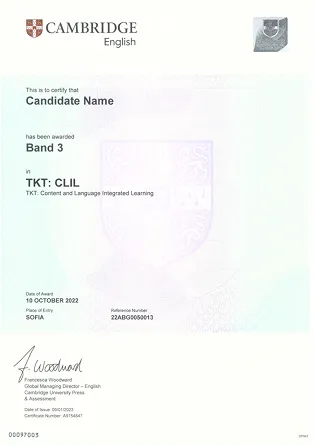
- International Certificate from Cambridge Assessment English
You are under no obligation to sit the official exam after completing the course. However, if your goal is to gain prestigious international recognition, you can register to take the TKT exam itself.
How to register for the TKT exam
The TKT is a paper-based exam, which means you will need to register for it well in advance.
You can sit TKT modules individually, or in any combination and sequence of your choice.
We are happy to assist you with the registration process through our partner exam centre in Poland.
Entry requirements
- Age: 18+
- English language proficiency: B1+ (Intermediate) or higher
- The following are a significant advantage but are not mandatory to start the course:
- 1+ years of group teaching experience (for the TKT YL module, experience working with young learners is preferred)
- A degree in Philology, Linguistics, or Pedagogy (Education)
How to join the course
-
Submit your application
-
Confirm details with our manager
-
Pay for the course
Please read the detailed terms and conditions for participating in our TKT courses. Details

More modules, bigger savings!
Boost your teaching skills and save on your training:
- 10% off when you prepare for 2 TKT modules
- 15% off when you prepare for 3 TKT modules

Your TKT guide: step-by-step tips, exam format, and peer experience on our blog Read the blog
What people say about us

Why trust Grade?
Grade is the largest authorised Cambridge English Qualifications exam centre in Ukraine.

18
years of experience in educational services
1,700+
teachers awarded Cambridge qualifications
200+
partner educational institutions
Join the Grade Teacher Training community


-
The latest news from the ELT world
-
Announcements of upcoming events, teaching tips, and methodological advice
-
Everything you need to know about teaching English

Get your first international qualification!


